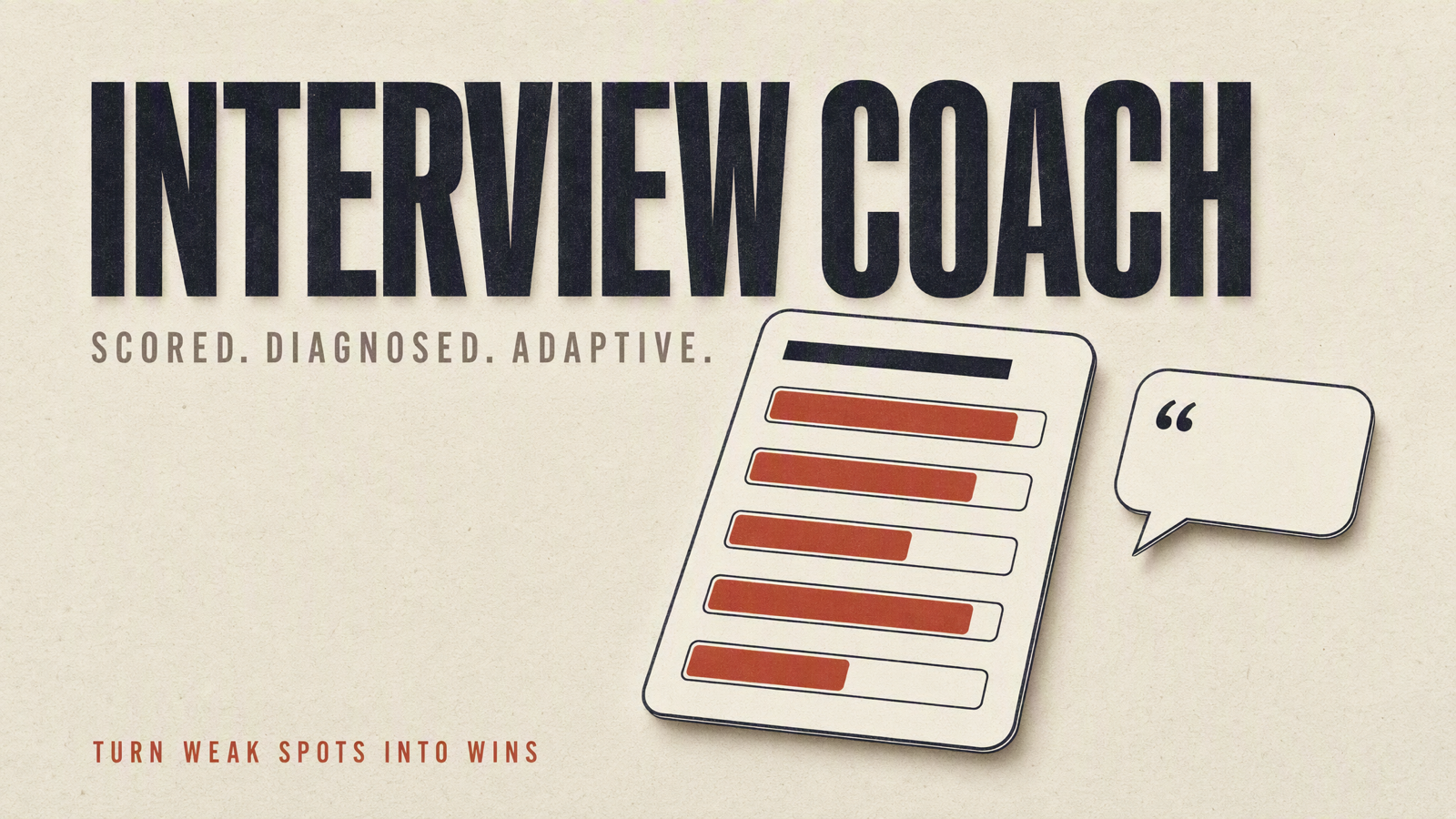
帮你针对性弥补面试短板,构建贴合目标职位的个人叙事,提升拿offer概率,高效规划全求职流程。
详细介绍
Interview Coach
A Claude Code-based interview coach that covers the full job search lifecycle — from JD analysis and resume optimization through mock interviews to post-offer negotiation. 23 commands across application materials, interview prep, practice, analysis, and comp coaching. It scores your answers across five dimensions, diagnoses root causes behind weak spots, builds a storybank you can retrieve under pressure, and adapts its coaching to your specific patterns. Not a generic question bank. An adaptive system that gets sharper the more you use it.
Say kickoff , share your resume, and you're being coached in under 2 minutes.
What It Does
Scoring and diagnosis — Every answer scored on Substance, Structure, Relevance, Credibility, and Differentiation, calibrated to your seniority. Scores map to root causes (status anxiety, narrative hoarding, conflict avoidance) with targeted fixes, not just "do better."
Adaptive coaching — After scoring, a decision tree triages your bottleneck and branches to the right drill. If Relevance is your gap, you get question-decoding practice. If Substance, you build raw material. The system doesn't cycle through the same sequence for every candidate.
Multi-format transcript analysis — Paste raw transcripts from Otter, Zoom, Grain, Google Meet, Teams, Tactiq, Granola, or any other tool. The system auto-detects the format and normalizes it. Analysis adapts to interview type: behavioral interviews get Q&A parsing, system design gets phase-based analysis (scoping, approach, deep-dive, tradeoff, adaptation), panel interviews track cross-interviewer dynamics, and mixed formats handle mode-switching between technical and behavioral segments. Each format gets its own anti-pattern detection and additional scoring dimensions.
Storybank with portfolio optimization — Structured story management with full STAR text, earned secrets, strength ratings, and rapid-retrieval drills. Story-to-question mapping uses a 4-level fit scoring system (Strong Fit, Workable, Stretch, Gap) with portfolio optimization that resolves conflicts when multiple questions compete for the same story, tracks freshness and overuse, and prioritizes stories with strong earned secrets. Narrative identity extraction finds the 2-3 core themes across your stories so every answer reinforces a coherent thesis about who you are.
Practice and mocks — 8-stage drill progression (constraint ladders, pushback handling, pivot drills, panel simulations, stress tests) plus full 4-6 question mock interviews in behavioral, system design, case study, panel, and technical+behavioral formats. Every round includes the interviewer's perspective — what they were actually thinking when you spoke. Role-drill scores map to core dimensions so specialized practice feeds into overall trend analysis. At Directness Level 5: expanded interviewer inner monologue, challenge notes on rounds 3+, and optional warmup skip.
Outcome calibration — The system tracks whether its practice scores actually predict real interview outcomes. After 3+ real interviews, it runs scoring drift detection, identifies when external feedback contradicts coach scoring, and recalibrates. Cross-dimension root causes (like "conflict avoidance" affecting both Substance and Differentiation) get unified treatment instead of separate drills. The system also learns from successes — tracking which stories, dimensions, and patterns correlate with advancement.
Role-fit assessment — Structured evaluation of candidate-role fit across five dimensions (requirement coverage, seniority alignment, domain relevance, competency overlap, trajectory coherence). Distinguishes strong fits from investable stretches and long shots, so candidates focus their energy on roles where they're competitive. Over time, rejection patterns reveal targeting insights that no amount of practice can fix.
Enhanced company intelligence — Three research depth levels (Quick Scan, Standard, Deep Dive) with a structured search protocol and claim verification. Every company-specific claim maps to a source tier (verified, general knowledge, or unknown). Prep briefs include targeted web research before applying company knowledge, with source attribution for every finding.
Interview lifecycle — Company research, role-specific prep briefs with interviewer intelligence, same-day post-interview debrief, outcome tracking that correlates practice scores with real results, and post-offer negotiation coaching with exact scripts.
Interview intelligence — The system learns from your real interview experiences. Every transcript, debrief, and recruiter feedback adds to a personalized knowledge base: question patterns across companies, what works and what doesn't for you specifically, and feedback-outcome correlations. Intelligence data has temporal decay — stale data is flagged, not silently relied on.
Session continuity — A persistent coaching_state.md file tracks your storybank, scores, patterns, drill progression, interview loops, interview intelligence, and calibration state across sessions. Pick up where you left off, weeks later. Saves are automatic.
Challenge protocol (Directness Level 5) — At the highest directness setting, the coach actively challenges you through five lenses: Assumption Audit, Blind Spot Scan, Pre-Mortem, Devil's Advocate, and Strengthening Path. Stories get red-teamed after you add or improve them. Transcripts get challenged. Practice rounds 3+ include a rotating challenge note. Progress reports include a Hard Truth section. Hype includes a pre-mortem before interviews. Rejections get mined for leverage. The system also detects avoidance patterns — if you keep steering away from a weakness, it names it directly. Every challenge ends with a concrete fix. Levels 1-4 are completely unaffected.
Guided flow — The coach recommends a specific next step after every command based on your coaching state — not a generic menu. When you say something like "prepare me for my interview at Google," it detects the multi-step intent and walks you through the full sequence (research, prep, concerns, hype) with natural transitions. Session start greetings include a prescriptive recommendation for the highest-leverage move right now.
LinkedIn profile optimization — Section-by-section audit of your LinkedIn profile against how the platform actually works: recruiter boolean search mechanics, algorithm distribution, and section-specific impact. Three depth levels from quick audit to deep optimization with content strategy. Not a resume-to-LinkedIn copy — a platform-native optimization that treats LinkedIn as its own game.
Resume optimization — Holistic resume audit across every dimension that actually affects outcomes: ATS parsing and ranking, recruiter scan behavior, bullet quality, seniority calibration, keyword coverage, structure, concern management, and cross-surface consistency. Three depth levels from quick audit to deep optimization with full bullet rewrite pipelines. When a storybank exists, the system mines it for quantified outcomes and earned secrets that should appear in resume bullets. When a JD is available, it produces a targeted version optimized for that specific application. Not a grammar check — a strategic overhaul of the resume as a job-search artifact.
Core positioning — Builds the atomic unit of self-presentation: a positioning statement that distills who you are into a compelling, memorable core. Uses curiosity gap principles, earned secret anchoring, and the Present-Past-Future formula to produce variants at every duration (10-second elevator, 30-second networking, 60-second recruiter call, 90-second interview TMAY) plus a LinkedIn summary hook. The positioning statement is saved to coaching state and consumed by resume, linkedin, and outreach for cross-surface consistency. Three depth levels from quick draft to deep positioning with a full differentiation audit.
Networking outreach coaching — Coaches the full outreach lifecycle: cold LinkedIn messages, warm introduction requests, informational interview asks, recruiter replies, follow-up sequences, and referral requests. Three depth levels from quick templates to full networking campaigns with multi-channel strategy. Messages are built on the candidate's Positioning Statement so every outreach is differentiated, not generic. The system knows platform mechanics (LinkedIn's 300-char connection request limit, optimal cold email length of 75-125 words, InMail response rates) and coaches accordingly. Includes a message quality rubric, follow-up cadence guidance, and the research showing that referrals account for 30-50% of hires from only 7% of applicants.
JD decoding and batch triage — Analyzes job descriptions using six decoding lenses (repetition frequency, order and emphasis, required vs. nice-to-have, verb choices, between-the-lines signals, and what's missing) with confidence labels on every interpretation. Maps extracted competencies against the candidate's profile for a fit verdict. Generates specific questions to ask the recruiter for every uncertain interpretation. Batch triage mode compares 2-5 JDs to find the candidate's market-validated sweet spot and recommend where to invest application effort. Includes a teaching layer so candidates learn to decode JDs themselves over time.
Presentation round coaching — Fills the prep gap for presentation-format interviews (system design presentations, business cases, portfolio reviews, strategy presentations, technical deep dives). Coaches narrative structure using four arc frameworks, optimizes openings and closings, calibrates content density against time limits (at ~130-150 words per minute), and prepares for Q&A with predicted questions and answer strategies. Three depth levels from quick structural framework to deep preparation with talk track review and constraint versions.
Early-process comp coaching — Coaches the highest-leverage compensation moments: the recruiter screen "what are your salary expectations?" question, salary history handling, and application form strategy. Guides candidates through comp research (without fabricating data), helps construct a defensible range, and provides stage-specific scripts with backups for pushback. Covers the full pre-offer comp timeline and hands off to the negotiate command when a formal offer arrives. Three depth levels from a quick 30-second script to full career-transition comp positioning.
Differentiation — Earned secrets and spiky POVs are a first-class dimension, not an afterthought. The system pushes you past "competent" toward "memorable."
Self-awareness — Tracks the gap between your self-assessment and actual coach scores. Knows if you're an over-rater or under-rater, and adjusts coaching accordingly.
Quick Start
Option 1: Claude Code (recommended)
Clone the repo:
git clone https://github.com/noamseg/interview-coach-skill.git
cd interview-coach-skill
Or download it as a ZIP and unzip.
Activate the coach by renaming the skill file:
mv SKILL.md CLAUDE.md
Open the folder in Claude Code and say kickoff .
Requires any paid Claude plan. Also works with Claude Code (terminal), Cursor, or any environment with file system access.
Option 2: OpenAI Codex
Clone the repo:
git clone https://github.com/noamseg/interview-coach-skill.git
cd interview-coach-skill
Or download it as a ZIP and unzip.
Activate the coach by renaming the skill file:
mv SKILL.md AGENTS.md
Open the folder in Codex and say kickoff .
Requires any paid ChatGPT plan.
For both options, the coach will ask for your resume, target role, and timeline — then build your profile, assess your starting point, and give you a prioritized action plan. Everything saves automatically to coaching_state.md so you pick up where you left off next session.
Commands
Getting Started
Command
Purpose
Typical Output
kickoff
Setup profile, track, and preferences
Kickoff summary + time-aware action plan
Interview Round Prep
Command
Purpose
Typical Output
research [company]
Company research + structured fit assessment (3 depth levels)
Company snapshot, culture signals, fit assessment, claim-verified findings
decode
JD analysis + batch triage (3 depth levels, 6 lenses)
Confidence-labeled decoding, competency extraction, fit assessment, recruiter verification questions, batch comparison, teaching layer
prep [company]
Build role-specific prep brief (format-aware, culture-aware, role-fit assessment)
Format guidance, culture read, role-fit assessment, interviewer intelligence, competencies, predicted Qs, story mapping
concerns
Anticipate interviewer concerns
Concern-counter-evidence map
questions
Generate interviewer questions
5 tailored, non-generic questions
present
Presentation round coaching (3 depth levels)
Narrative arc selection, content structuring, timing calibration, opening/closing optimization, Q&A preparation, constraint versions
Application Materials
Command
Purpose
Typical Output
linkedin
LinkedIn profile optimization (3 depth levels)
Section-by-section audit, rewritten sections, content strategy
resume
Resume optimization (3 depth levels, JD-targeted when available)
ATS audit, section-by-section assessment, bullet rewrites, seniority calibration, keyword analysis, storybank-to-bullet pipeline
pitch
Core positioning statement + context variants
Core statement, constraint ladder, context-specific pitches, positioning consistency check
outreach
Networking outreach coaching (3 depth levels, 9 message types)
Message frameworks, draft critique + rewrite, follow-up sequences, multi-channel campaign strategy
apply [company]
Draft written answers to job application screening questions
Story selection menu per question (with domain match flagging), ready-to-paste answers, prior answer reuse, flagged gaps
Pre-Conversation
Command
Purpose
Typical Output
salary
Early/mid-process comp coaching (3 depth levels)
Comp research guidance, range construction, stage-specific scripts, total comp education, salary history handling
hype
Pre-interview confidence + psychological warmup. At Level 5: includes a pre-mortem with failure prevention
60-second reel + 3×3 sheet + focus cue + recovery playbook
Practice and Simulation
Command
Purpose
Typical Output
practice
Run drill rounds (with progression gating). At Level 5: challenge notes, expanded interviewer read, optional warmup skip
Round debrief + self-assessment delta + targeted adjustment
mock [format]
Full simulated interview (4-6 Qs) — behavioral screen, deep behavioral, panel, bar raiser, system design/case study, technical+behavioral mix
Holistic arc feedback, signal-reading notes, energy trajectory
stories
Build/manage storybank + rapid-retrieval drill. At Level 5: stories get red-teamed with 5 challenge lenses
Story table + earned secrets + gap analysis + retrieval drill
Analysis, Tracking, and Post-Interview
Command
Purpose
Typical Output
analyze
Analyze transcript with format-aware parsing, triage-based coaching, and interviewer's inner monologue. At Level 5: includes structured challenge
Auto-detected format, per-unit scoring (Q&A/phases/exchanges), format-specific dimensions, decision tree + interview delta
debrief
Post-interview rapid capture (same day)
Questions recalled, interviewer signals, stories used, coaching state updates
progress
Trends, self-calibration, outcome tracking, scoring calibration. At Level 5: includes a Hard Truth section
Self-assessment delta + outcome correlation + scoring drift detection + root cause tracking + coaching meta-check
feedback
Capture recruiter feedback, outcomes, corrections, context, or coaching meta-feedback. At Level 5: rejections include structured leverage extraction
State updates + next step suggestion
thankyou
Post-interview follow-up drafts
Thank-you note + variants
negotiate
Post-offer negotiation coaching
Offer analysis + strategy + scripts + specific language
reflect
Post-search retrospective + archive
Journey arc, breakthroughs, transferable skills, archived state
help
Show command menu (context-aware)
Full command list + recommended next based on coaching state
Fast Workflow Examples
1) Initial setup
kickoff
Expected output:
Track selected ( Quick Prep or Full System )
Profile snapshot (strength signals and concern areas)
Interview readiness assessment
Time-aware action plan (adjusted to your interview timeline)
2) Company research (before committing to prep)
research Notion
Expected output:
Company snapshot (stage, size, culture signals — claim-verified with source tiers)
Fit assessment against your profile
"If you decide to apply" next steps
For high-priority targets, mention you want a deep dive: "Do a deep dive on Notion" — gets you employee posts, product reviews, competitor analysis, and leadership profiles on top of the standard research.
3) Before an interview
prep Stripe
Then provide:
Job description
Role/seniority
Optional interviewer LinkedIn URLs (for per-interviewer intelligence)
Expected output:
Interview Format (with format-specific coaching boundaries)
Company Culture Read
Interviewer Intelligence (if profile links provided — per-interviewer lens, focus areas, rapport hooks, story recommendations)
What They Optimize For
Your Best Positioning
Likely Concerns + Counters
Predicted Questions (7-10)
Story Mapping
Questions To Ask Them
Day-Of Cheat Sheet
4) Right after an interview
debrief
Rapid capture while details are fresh — works with or without a transcript. Get:
Questions recalled and reconstructed answers
Interviewer signals observed (engagement, skepticism, interest)
Stories used (auto-updates storybank Last Used dates)
Coaching state updated for the next session
5) Analyzing a transcript
analyze
Then paste raw transcript text from any tool (Otter, Zoom, Grain, Teams, etc.). The system auto-detects the format and normalizes it.
Expected output:
Format detection and normalization
Per-unit score blocks (Q# for behavioral, P# for system design phases, E# for panel exchanges)
Scorecard
Triage Decision (data-driven coaching path based on your patterns)
What Is Working
Top 3 Gaps To Close
Storybank Changes
Priority Move (Next 72 Hours)
6) Drill practice
practice
Drills (in progression order — advance when you meet gating thresholds):
practice ladder — Constraint drills (30s, 60s, 90s, 3min)
practice pushback — Handle skepticism and interruption
practice pivot — Redirect when questions don't match prep
practice gap — Handle "I don't have an example" moments
practice role — Role-specific specialist scrutiny
practice panel — Multiple interviewer personas
practice stress — High-pressure simulation
practice technical — Thinking out loud, clarification-seeking, tradeoff articulation (system design / case study / mixed format only)
Standalone (not gated):
practice retrieval — Rapid-fire story matching under time pressure
Expected output each round:
Round Debrief
What Worked
Gaps
Scorecard (5 dimensions)
Self-Assessment Delta
Next Round Adjustment
7) Full mock interview
mock behavioral Stripe
Runs a complete 4-6 question interview simulation. Formats: behavioral screen, deep behavioral, panel, bar raiser, system design/case study, technical+behavioral mix. Holistic feedback on:
Overall impression and hiring signal
Energy trajectory and pacing across the full arc
Story diversity and selection quality
Signal-reading (did you adapt to interviewer cues?)
Per-question scoring + holistic patterns only visible across the full session
8) Decode a JD before applying
decode
Then paste the job description. Get:
Competency extraction with confidence labels (HIGH/MEDIUM/LOW)
6-lens analysis (repetition frequency, order, required vs. nice-to-have, verb choices, between-the-lines signals, what's missing)
Fit assessment against your profile (Strong Fit / Investable Stretch / Long-Shot Stretch / Weak Fit)
Recruiter verification questions for uncertain interpretations
Teaching layer so you learn to decode JDs yourself
For multiple JDs: paste 2-5 and get batch triage with ranking, your market-validated sweet spot, and allocation recommendations.
9) Build your positioning statement
pitch
Get:
Core positioning statement anchored to your strongest earned secret
Context variants: 10-second elevator, 30-second networking, 60-second recruiter, 90-second interview TMAY
Positioning consistency check across resume, LinkedIn, and interview narrative
10) Coach an outreach message
outreach
Then specify message type (cold LinkedIn, warm intro, recruiter reply, etc.) and target. Get:
Draft critique (if you bring a draft) or guided construction
Rewritten message within platform constraints (300 chars for LinkedIn connection requests)
Follow-up sequence with timing
Earned secret hooks pulled from your storybank
11) Answer job application screening questions
apply HireRight
Then provide:
List of application questions (paste them directly)
Optional: JD (used for domain matching and "why us" questions)
Optional: word or character limits per question
Expected output:
Per-question story selection menu (2-3 options, with [Domain match] flag when a story comes from the same industry as the company)
Prior answer suggestions when a similar question was answered for another company
Ready-to-paste written answers in written register (150-200 words each, tighter than spoken interview answers)
Flagged gaps where storybank or resume evidence is missing — no answer gets fabricated
Answers are saved to job-search/[company]_application.md and reused as a library across future applications.
12) Post-offer negotiation
negotiate
Then provide offer details, competing offers, and ideal outcome. Get:
Market position analysis
Negotiation strategy with priority ordering
Exact scripts for the conversation
Fallback language for pushback
Tracks
Quick Prep
Best when interview timeline is short.
Company research
Prep brief
Focused transcript analysis
Immediate next actions
Full System
Best when running a multi-week search.
Storybank management with rapid-retrieval drills and portfolio-optimized story mapping
Multi-format transcript analysis (behavioral, system design, panel, mixed) with decision tree triage
Pattern and trend tracking with self-assessment calibration
Differentiation coaching integrated into all workflows
Full mock interview simulations (behavioral, system design, case study, panel, technical+behavioral mix)
Drill progression with gating thresholds (8 stages + standalone retrieval)
Post-interview debrief and rapid capture
Outcome tracking (correlate practice with real results) with scoring calibration (drift detection, recalibration)
Interview intelligence — learns question patterns, what works/doesn't, and company-specific insights from your real interviews, with temporal decay on stale data
Interview loop awareness across company rounds
Post-offer negotiation coaching
Post-search retrospective and archiving
Choose during kickoff . You can switch later.
Repository Structure
interview-coach-skill/
├── SKILL.md # Core skill — rename to CLAUDE.md to activate
├── README.md # This file
├── LICENSE # MIT License
├── coaching_state.md # Created on first kickoff (persistent memory, auto-saved)
└── references/
├── commands/ # Per-command workflows (loaded on demand)
│ ├── kickoff.md
│ ├── research.md
│ ├── prep.md
│ ├── analyze.md
│ ├── debrief.md
│ ├── practice.md
│ ├── mock.md
│ ├── stories.md
│ ├── concerns.md
│ ├── questions.md
│ ├── linkedin.md
│ ├── resume.md
│ ├── pitch.md
│ ├── outreach.md
│ ├── decode.md
│ ├── present.md
│ ├── salary.md
│ ├── hype.md
│ ├── thankyou.md
│ ├── progress.md
│ ├── negotiate.md
│ ├── feedback.md
│ ├── apply.md
│ ├── reflect.md
│ └── help.md
├── cross-cutting.md # Shared modules: gap-handling, signal-reading, differentiation, cultural awareness, psychological readiness, cross-command dependencies
├── rubrics-detailed.md # Scoring anchors, root causes, seniority calibration
├── role-drills.md # Role-specific drills + interviewer archetypes
├── differentiation.md # Earned secrets, spiky POVs, clarity under pressure
├── transcript-processing.md # Step-by-step transcript analysis guide (format-aware parsing)
├── transcript-formats.md # Format detection + per-format normalization (Otter, Zoom, Grain, etc.)
├── storybank-guide.md # Story management + rapid-retrieval drill
├── story-mapping-engine.md # Portfolio-optimized story mapping with fit scoring
├── calibration-engine.md # Scoring drift detection, root cause tracking, success patterns
├── challenge-protocol.md # Five-lens challenge framework (Level 5 only): assumption audit, blind spot scan, pre-mortem, devil's advocate, strengthening path
└── examples.md # Worked examples: scored answers, triage, rewrites, system design analysis
Best Results
Share a real resume (not a high-level summary).
Include a full job description for prep — and the interview format if you know it.
Use real transcripts for analyze . The more you give it, the better the triage.
Keep a living storybank with stories . Extract earned secrets for every story.
Run progress weekly — it tracks your self-assessment accuracy, not just scores.
After real interviews, log outcomes. The system correlates practice scores with real results.
When you hear back from a recruiter — good or bad — run feedback to capture it. The system learns from your real experiences over time.
Run mock before important interviews. Individual drills build skills; mocks test the full arc.
Use debrief the same day as a real interview — capture signals while they're fresh.
Run decode before applying — analyze the JD's language, assess your fit, and decide if the role is worth your time. Use batch triage to compare multiple JDs at once.
Run salary before your first recruiter call — the recruiter screen is the highest-leverage comp moment, not the offer negotiation.
Run present before a presentation round — structure your content and prepare for Q&A before you ever open PowerPoint.
Run apply when a job application includes screening questions — it surfaces domain-relevant stories, checks your storybank for evidence before drafting, and builds a reusable answer library across applications.
FAQ
How is this different from asking ChatGPT for interview help?
Generic LLM interview help gives you the same advice regardless of your patterns. This system scores you on five dimensions, tracks your scores over time, diagnoses root causes behind weak spots, builds a storybank with retrieval drills, and adapts its coaching based on what the data reveals. It remembers your previous sessions, knows which stories you've already used at a company, and changes its approach when something isn't working. It's the difference between a textbook and a coach.
Does this only work for tech roles?
No. Core workflows are role-agnostic; role drills include PM, Engineering, Design, Data Science, Research, Operations, and Marketing.
Why is the feedback direct?
The skill is intentionally high-candor and evidence-based. It uses strengths-first delivery and self-reflection before critique. It also periodically checks whether the coaching is landing and adapts if not. You can set your feedback directness level (1-5) during kickoff. At Level 5, the Challenge Protocol activates: stories get red-teamed, progress includes a Hard Truth, rejections get mined for leverage, and avoidance patterns are named directly. Levels 1-4 are gentler — same rigor, softer delivery.
How does it work across multiple sessions?
The skill writes a coaching_state.md file that tracks your storybank, scores, patterns, drill progression, interview outcomes, interview loops, and more. At the start of each session, it reads this file and picks up where you left off. Saves happen automatically after every major workflow — not just at session end.
Contributing
Open an issue or PR with:
Repro steps
Current behavior
Expected behavior
Suggested fix (optional)
Credits
Created by Noam Segal .
License
MIT
试试这样做
- 帮我启动面试教练,我准备申请谷歌的产品经理职位,请帮我做全流程面试准备
- 帮我分析这份目标职位JD,并针对性优化我的简历
- 帮我开展一场行为面试模拟,结束后给我的回答打分并给出改进方案
作者:noamseg èåºäºº / å¦çç 究è | GitHub Stars 2K | 标签:写作文案 知识管理 已认证 开源许可: MIT
来源:colaos.ai | Skill ID:interview-coach-skill


留言 0
还没有留言,快来抢沙发